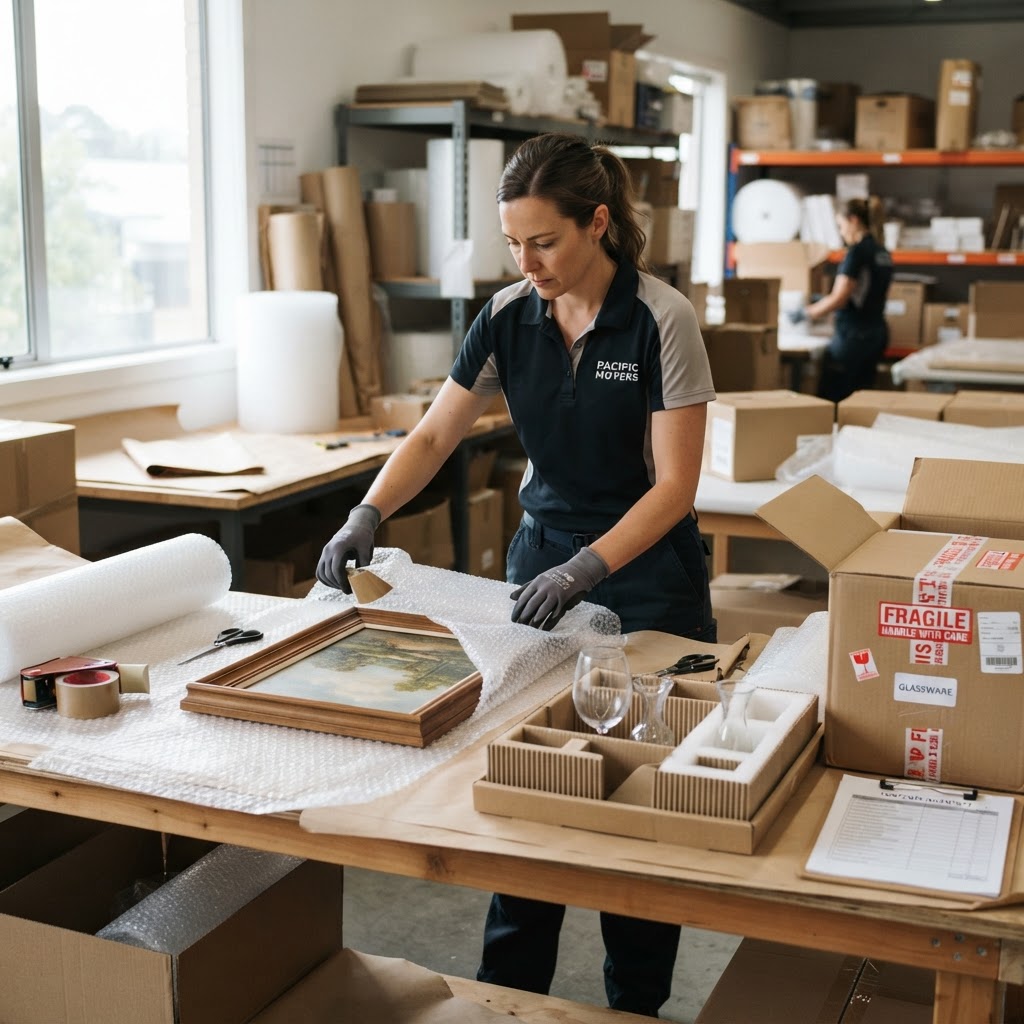
Most broken items don't break because someone dropped them. They break because the box shifted, the padding wasn't thick enough on the edges, or a heavy item sat next to a light one for six hours in a truck.
This is the part of packing where experience actually shows. Here's how our technicians treat the items you can't replace.
Why Fragile Items Break
Glass fails at its edges and corners, not its center. That's why wrapping a plate in a single sheet of newspaper rarely helps — the rim is still exposed to the wall of the box. Every fragile item needs padding that wraps completely around the perimeter, plus a buffer between it and the next item.
Movement is the other culprit. A box that has empty space inside lets its contents shift with every turn of the truck. If you shake a sealed box and hear anything move, that box isn't finished yet.
The Wrap, the Box, and the Void
Three things decide whether a fragile item survives. First, the wrap: two to three layers of paper, tissue, or bubble wrap around the whole item, with extra layers on corners and rims. Second, the box: rigid, correctly sized, and never overfilled to the point that lids bulge. Third, the void fill: the cushioning that fills every gap so nothing slides.
Plates go on edge, never flat. Bowls and glasses get paper crumpled inside before they're wrapped. Small items travel in groups inside a larger padded box, never loose.
Mirrors, Artwork and Screens
Large flat items are their own category. A mirror or framed piece gets edge protection on all four sides, then a full wrap, then custom cardboard on both faces — nothing with a frame corner ever touches another object directly. Screens go into boxes sized for them, standing upright, with the screen surface never pressed against anything hard.
For unusually large pieces, we build the box around the item instead of searching for one that fits.
What Makes a Good Box Label
"FRAGILE" alone isn't enough. Label the item, the destination room, and which side must stay up. Write on the top and the side so the instruction is visible no matter how the box is stacked, and keep fragile boxes away from heavy ones in the load order.
Our digital checklist records exactly what went into each fragile box, so if something needs special handling at the other end, the crew already knows before they open it.
Frequently Asked Questions
Have fragile pieces you'd rather not risk? Book your packing service and we'll bring the right materials for the job.
Found this helpful?
Back to Blog